Cart 0

Your Visual Blueprint
Looking and feeling your best is not a formula borrowed from someone else — it is a discovery process that belongs to you. A style that flatters one person beautifully may fall flat on another, not because of taste, but because of the physical dimensions, colouring and personality each of us brings into a room.
We are visual beings. Long before a word is spoken, an impression has already formed. This module exists to help you understand your personal aesthetic — your shape, your colouring, your proportions and the way you present yourself — so that you can shape that impression deliberately, rather than leave it to chance.
| BEFORE WE BEGIN, CONSIDER What is my unique body shape? Which colours bring out the best in me? Where does my personal style naturally lean? How do I create balance and proportion in what I wear? |
The four sections that follow will help you answer each of these in turn. Used together, they form your personal image blueprint.
01 Shape — Understanding Your Body Architecture
Every body has an underlying architecture, and every architecture has a set of principles that make it look its most balanced. Knowing yours is not about limitation — it is about strategy. Once you understand your shape, you can dress to support it rather than work against it.
Body Shapes — Women

| Shape | Description | Dressing Principle |
| Hourglass | Bust and hip are balanced, with a clearly defined waist. | Emphasise the waist. Fitted and wrap styles work strongly in your favour. |
| Pear / Triangle | Hips are broader than the shoulders and bust. | Draw the eye upward with structured shoulders and statement necklines. |
| Inverted Triangle | Shoulders and bust are broader than the hips. | Soften the shoulder line; add volume through the lower body. |
| Apple / Round | Fuller through the midsection, with slimmer legs. | Elongate with vertical lines and unbelted, structured layers. |
| Rectangle | Bust, waist and hip are similarly proportioned. | Create the illusion of a waist through belts, seaming and layering. |
Body Shapes — Men

| Shape | Description | Dressing Principle |
| Trapezoid | Shoulders broader than the waist — the classic athletic build. | Most silhouettes work well; maintain the natural taper of the torso. |
| Rectangle | Shoulders, waist and hip are closely aligned. | Add structure through tailoring and layering to build definition. |
| Triangle | Waist and hip are broader than the shoulders. | Broaden the shoulder line with structured jackets and horizontal detail up top. |
| Inverted Triangle | Shoulders noticeably broader than the waist. | Balance with a straighter cut through the body and leg. |
| Oval | Fuller through the midsection. | Choose vertical lines, open collars and longer, unstructured layers. |
| Knowing your shape is not about limitation — it is about strategy. Once you understand your architecture, you can dress to support it, rather than fight it. |
02 Colour — Your Colour Story
Colour is one of the fastest ways to change how you are perceived — and one of the most personal. The starting point is not a trend or a favourite colour, but your own undertone: the warm or cool base beneath your skin.
| QUICK SELF-CHECK A simple test: look at the veins on the inside of your wrist in natural light. Green-toned veins usually point to a warm undertone. Blue or purple-toned veins usually point to a cool undertone. |
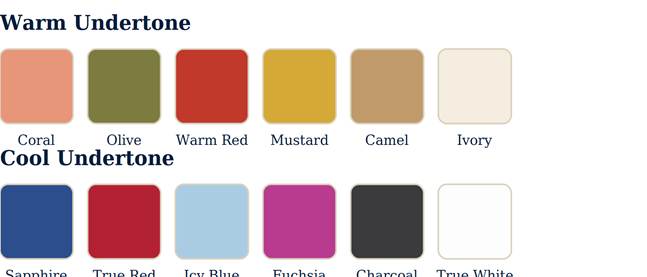
| Best Metals | Best Neutrals | Colours to Explore | |
| Warm | Gold, rose gold, bronze | Ivory, camel, chocolate brown | Coral, olive, warm red, mustard |
| Cool | Silver, platinum, white gold | True white, charcoal, navy | Jewel tones, true red, icy blue, fuchsia |
A small example of how much this matters: if your undertone leans warm, gold jewellery will consistently outperform silver on you. It is a small choice with an outsized visual effect — the kind of detail that, once known, is easy to use to your advantage every single day.
03 Proportion — Creating Visual Balance
Shape tells you the architecture you are working with. Proportion tells you how to arrange what you wear on top of it. The eye reads proportion before it reads detail — which means that even well-chosen colours and shape-appropriate cuts can look slightly off if the proportions of an outfit are not balanced.
| Principle | Effect | How to Use It |
| Vertical lines | Lengthen and slim | Pinstripes, long unbroken jacket lines, monochrome dressing |
| Horizontal breaks | Shorten and widen | Belts, contrasting hems, cropped jackets — use deliberately, not accidentally |
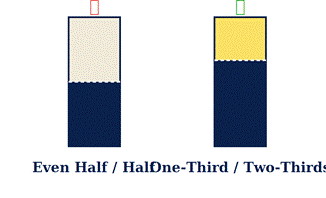
| The rule of thirds | Creates visual interest | Avoid splitting an outfit exactly in half at the waist; aim for a one-third to two-thirds balance instead |
| Fit at the shoulder | Anchors the whole outfit | A jacket that fits well at the shoulder makes everything below it look more intentional |
| Hem length | Changes leg proportion | A hem that hits at the narrowest point of the leg is more flattering than one at the widest point |
| Proportion is the fastest fix in your wardrobe. Before you change your shape or your colours, check your proportions — a well-placed belt or the right hem length can transform an outfit in seconds. |
Bringing It Together
Shape tells you what you are working with. Colour tells you what will draw people in. Proportion tells you how to arrange it all so the eye reads you the way you intend. Together, they form your personal image blueprint.
That blueprint becomes powerful the moment you use it to shape how others perceive your brand. You become successful at brand development when the people around you begin to associate you with your intended message — and that association starts with what they see.
| “Good clothes open all doors.” — Thomas Fuller (1608–1661) |
04 Style Personality — Where You Naturally Lean
Beyond shape and colour lies a third, more personal layer: the mood your style naturally gravitates toward. Most people lean toward one or two of the five broad style personalities below.

| Style | Signature | Might Suit You If… |
| Classic | Tailored, clean lines, minimal fuss | You value quality over trend and prefer investment pieces. |
| Dramatic | Bold, graphic, statement-making | You’re drawn to strong silhouettes and aren’t afraid to stand out. |
| Romantic | Soft fabrics, curved lines, detail | You gravitate toward femininity, texture and softness. |
| Natural | Relaxed, comfortable, unstructured | You prioritise ease and dislike intricate or fussy detail. |
| Creative / Gamine | Playful mixing, unexpected combinations | You enjoy experimenting and mixing styles in your own way. |
| Most people are a blend of two directions rather than a single pure type. The goal is not to fit a box — it is to notice the pattern in what you are already drawn to, and then buy on purpose instead of by accident. |
05 Dress Code — Reading the Room
What you wear shapes both how others perceive you and how you perform — the same principles of Primacy Effect and Enclothed Cognition explored elsewhere in this programme. The framework below translates that principle into a practical, everyday dress code guide, built around three categories plus a digital variant.
Category One — Power Dressing
The image consultant John T. Molloy, known for his research into executive dress, found that men and women are more likely to be perceived as authoritative and credible when wearing dark, saturated colours such as black, navy and charcoal. Power dressing is designed to make you look and feel persuasive, and it will maximise your professional impact.
| When to Wear | Colours | What to Wear |
| First client meetings, audit committees, executive management meetings, AGMs, presentations or proposals. | The darkest end of the spectrum — black, French navy or charcoal. Earthy tones read as the weakest in a power context. | Tailored, long-sleeved two-piece suits. A shift dress with a long-sleeved jacket works equally well for women. |
Category Two — Business Dress
Lighter suiting in tones such as grey and blue reads as approachable and likeable, though it will not carry quite the same authority as Category One. Brown is the weakest colour in this spectrum and is best avoided in a business context.
| When to Wear | Colours | What to Wear |
| Meeting a conservative client with whom you already have an established relationship. | Mid-tone suiting. Avoid very light colours such as white or pale yellow. | Shorter sleeve lengths are acceptable. A shift dress with a matching jacket is a strong choice for women. |
Category Three — Business Casual
This category is designed to relax the environment without losing professionalism. Get it wrong, and it can quietly undercut your credibility — the aim is to look considered even when you are dressing down.
| When to Wear | Colours | What to Wear |
| Established client relationships in a relaxed setting, or everyday internal office wear for those not client-facing. | As per your natural colour palette — relaxed, but still deliberate. | Smart, well-fitted separates. Avoid anything that reads as loungewear. |
The Digital Dress Code
The digital dress code applies to all online engagements. Map your meeting back to the categories above: external stakeholders and interviews call for Power Dressing; internal, formal meetings call for Business Dress; informal or casual-day meetings call for Business Casual.
| When to Wear | Colours | What to Wear |
| All online engagements. | As per the relevant category above. Avoid neon and other high-pigment shades, which reflect too much light and can be distracting on camera. | Complete outfits, not only from the waist up. Choose fitted rather than loose clothing — loose fabric distorts shape on camera, especially when seated. |
| “When you dress with intention, you’re not just walking into a room. You’re announcing who you are before you say a word.” — Gail Cameron |